


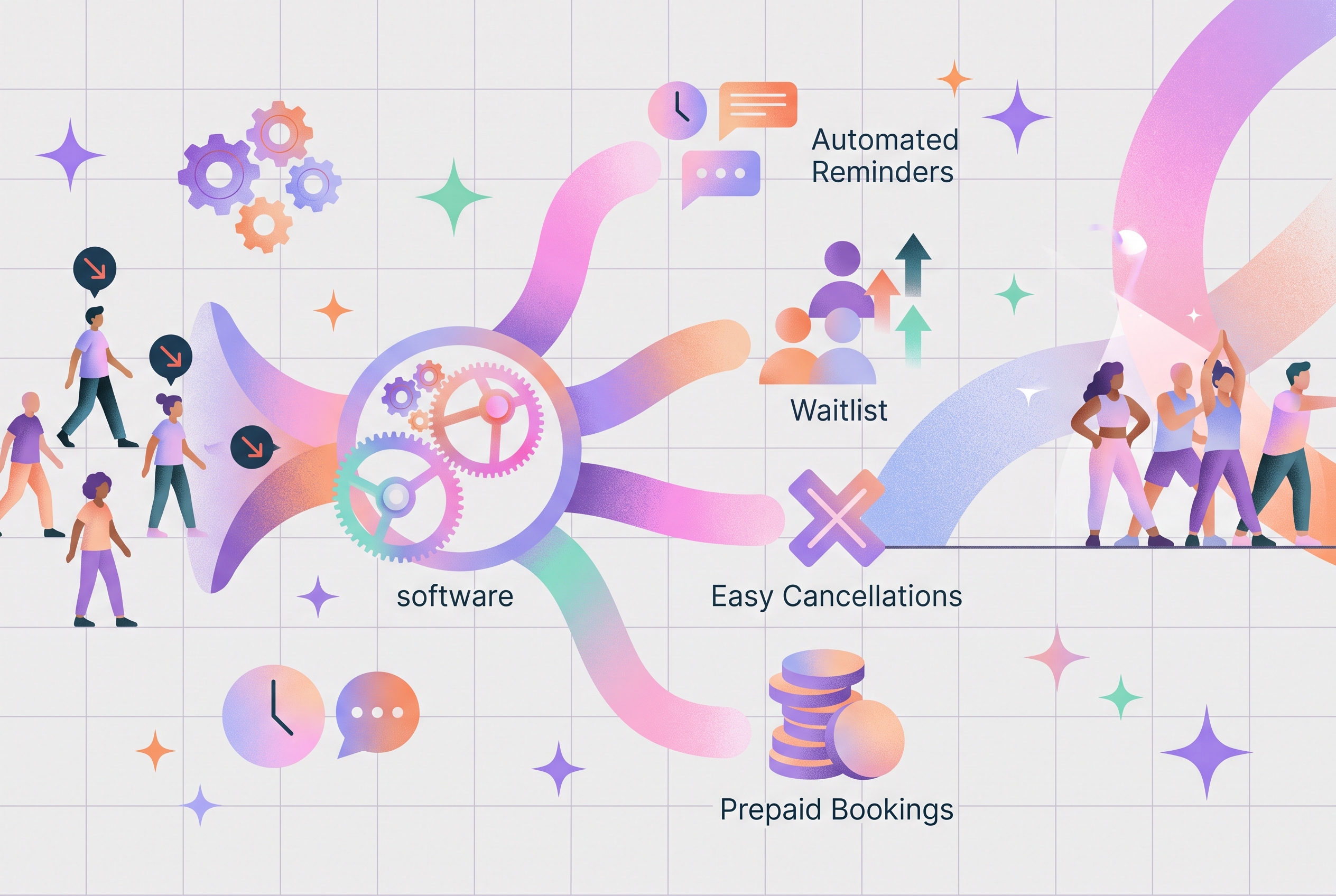

Every empty spot in a booked-out class is money you already turned away. The good news? Learning how to reduce gym no-shows with software comes down to five levers: automated reminders, cancellations that take one tap, waitlists that fill freed spots instantly, a policy your system enforces for you, and bookings people have already paid for. In this guide, you'll get seven tactics, a reminder timeline you can copy, and honest numbers from real gyms.
Why no-shows cost more than an empty spot
Start with the math, using illustrative figures: if a class spot is worth $15 and you lose ten spots a week to no-shows, that's roughly $7,800 a year, from one class alone. The knock-on costs are just as real: a half-empty room flattens the energy that group training sells, coaches prepare for people who never arrive, and, worst of all, every no-show may have blocked a spot another member actually wanted. You paid for the hour either way.
Why do members skip classes they booked?
Almost every no-show traces back to one of four causes.
They forgot: the booking was three days ago and life moved on.
Nothing was at stake: a free, unlimited booking costs nothing to ignore.
Canceling was harder than skipping: if freeing a spot means calling the front desk, people just don't show.
And sometimes, life happened. The first three are preventable, and each one maps to a specific software feature, which is exactly what the tactics below do.
How to reduce gym no-shows with software (7 tactics)
Each tactic below maps to one software feature you probably already pay for.
1. Send automated class reminders
Forgetting is the most fixable cause of no-shows, and the strongest evidence for reminders comes from healthcare: studies have found that appointment reminders cut missed visits by roughly a third. Gyms aren't clinics, but the mechanism is identical. Set the sequence once and let it run:
2. Make canceling as easy as booking
It sounds backwards, but hard-to-cancel systems create no-shows: if freeing a spot means calling reception during opening hours, members skip silently instead. When cancellation is one tap in the app, the spot comes back into play in seconds, and your waitlist can do something with it.
3. Let the waitlist fill the gap
An auto-filling waitlist is the difference between a cancellation and an empty spot. The moment someone drops out, the next member gets the place. It also quietly changes behavior: knowing someone else wants the spot makes people likelier to cancel properly rather than ghost.
4. Set a cancellation policy the system enforces
Pick a cancel window that fits your model; many gyms use somewhere between 4 and 24 hours. Decide the consequence for breaking it: a small fee, a forfeited class credit, or a strikes system. Then let the software apply it every time, for everyone. A policy your platform enforces automatically feels fair; one your front desk has to argue about breeds resentment. Communicate it at sign-up and in every booking confirmation. Our guide on handling frustrated fitness clients covers how to keep those conversations positive.
5. Take payment or credits up front
A class that's already paid for gets attended. Prepaid class packs, memberships with booking credits, and card-on-file payments all create the small stake that a free unlimited booking lacks. This isn't about punishing members; it's about making a booking feel like the commitment it is.
6. Watch attendance data for patterns
Your booking system already knows who books, who shows, and who quietly stopped coming. Review the reports monthly: a time slot with chronic no-shows may be a schedule problem, not a member problem. And a member whose attendance is sliding is your next retention case. For how to turn those reports into decisions, see making data-driven decisions as a fitness coach.
7. Reach out before a lapse becomes a cancellation
A drop in attendance usually shows up weeks before a cancellation does. When the data flags a member who's gone quiet, a personal message from their coach beats any automated campaign. Pair that early-warning system with the plays in our top client retention strategies and the tools and techniques that keep clients motivated.
What happens when booking friction disappears?
To be straight with you: none of our case studies measured no-show rates directly. What they did measure is what happens when booking and canceling get radically easier, and the same features driving those numbers (simple self-service bookings, reminders, one place to manage everything) are the ones that get people to class:
The pattern across all three: when booking takes seconds, members book more, and a member who booked in ten seconds on their phone is a member who can cancel properly in ten seconds too, instead of just not turning up.
What software features do you need to stop no-shows?
You don't need a separate tool for each tactic. You need one platform that covers the set:
- Automated notifications: booking confirmations and class reminders that send themselves.
- Self-service booking and canceling: one tap each way, in a member app.
- Waitlists: freed spots offered to the next member automatically.
- Payments built in: memberships, class packs, and credits that put a stake behind every booking.
- Attendance reporting: no-show patterns by class, time slot, and member.
LegitFit covers all five in one platform (bookings, automatic payments, waitlists, notifications, and reporting) so the tactics above run in the background while you coach. You can see how class and appointment scheduling handles reminders, waitlists, and cancellations in practice. For the broader checklist, see the key features you can't ignore in fitness studio management software.
Make no-shows the exception
No-shows aren't a member-discipline problem; they're a systems problem. Remove the forgetting with automated reminders, remove the friction with one-tap cancellations and auto-filling waitlists, add a small stake with prepaid bookings and a policy your platform enforces, and let attendance data catch the stragglers early. Set it up once, and the seven tactics above run every day without you.
Frequently asked questions
What is a good no-show rate for a gym?
There's no reliable industry benchmark: rates vary widely by class type, time slot, and booking model, and published figures are rarely well-sourced. The practical approach is to measure your own baseline for two to four weeks, then track the trend after each change. Improvement against your own numbers is what matters.
Do automated reminders actually reduce no-shows?
The strongest evidence comes from healthcare, where studies have found appointment reminders cut missed visits by roughly a third. Gyms aren't clinics, but the mechanism is the same: people simply forget. A confirmation at booking, a reminder the day before, and a nudge an hour or two out covers it.
Should you charge a no-show or late-cancellation fee?
Many gyms charge a small late-cancellation or no-show fee, while others prefer credit forfeits or a strikes system. Whichever you choose, let your software apply it automatically and consistently. A policy enforced by the system feels fair; one enforced through awkward front-desk conversations usually doesn't.
When should you send class reminders?
A three-touch pattern works well: an instant confirmation when the member books, a reminder about 24 hours before class, and a final nudge one to two hours out. Push notifications and SMS tend to get seen fastest, and personalized messages (name, class, coach, time) outperform generic ones.
Do waitlists reduce no-shows?
Yes, in two ways. An auto-filling waitlist turns cancellations into attendance by instantly offering freed spots to the next member. And it changes behavior: members who know someone else wants their spot are more likely to cancel properly instead of silently skipping, which keeps classes full either way.
Can software eliminate no-shows completely?
No. Life happens, and some missed classes are unavoidable. What software does is remove the main preventable causes: forgetting, friction, and zero stakes. Between reminders, easy cancellation, waitlists, and prepaid bookings, most of the gap between booked and attended closes, and the rest becomes data you can act on.





.jpeg)

.jpg)


Helping fitness business from day one
Trusted by fitness professionals worldwide to simplify day-to-day management and accelerate fitness business growth with clear, proven results.
Get demo & pricing